The Periodic Table
Everything you can touch, taste, breathe or hold — every star, every rock, every living thing — is built from about 100 simple ingredients. They are called elements. And one man organised them all into a pattern so powerful it predicted elements nobody had even discovered yet.
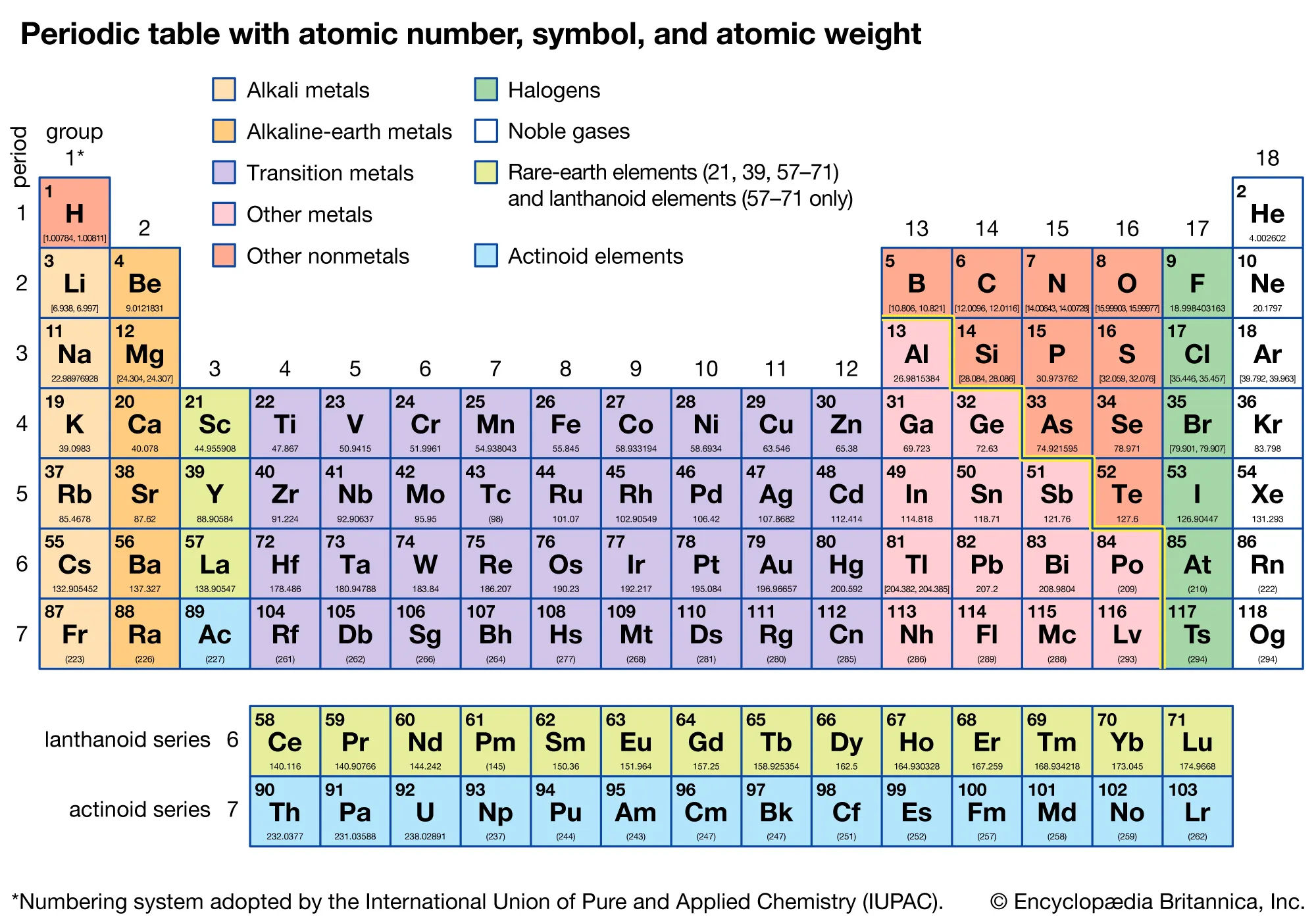
The map of absolutely everything
The Periodic Table is simply a list of all the different types of atom. Everything in existence is made by sticking these elements together. Water = Hydrogen + Oxygen. Rust = Iron + Oxygen. You = Carbon, Hydrogen, Oxygen, Nitrogen and a pinch of others.
But it is not just a list. It is arranged in rows and columns so that elements with similar properties sit together. Metals on one side, gases on another, strange colourful ones in the middle. It is the most powerful cheat sheet in all of science.
It came to him in a dream
The man who created the table we use today was a Russian chemist named Dmitri Mendeleev — and he did something nobody else had thought to do: he left gaps.
Where the pattern said there SHOULD be an element — but nobody had found it yet — Mendeleev simply wrote: "Here there will be one. It will weigh this much. It will behave like this." And over the next 20 years — one by one — they were discovered. Exactly as he described.
Legend says he fell asleep while struggling to arrange them — and saw the complete table perfectly ordered in his dream. Woke up and wrote it down. That is how close the pattern is to reality.
Surprising things about the elements
🧱 Most of your body is made of the lightest elements: Oxygen, Carbon, Hydrogen and Nitrogen. That means you are built from the same stuff as stars, trees and water.
💧 Some elements are literally explosive: Drop pure Sodium or Potassium into water — and they instantly catch fire, spin violently, and explode. That is why you never find them pure in nature — they are always locked up safely inside compounds.
✨ Gold comes from space: Heavy elements like Gold, Silver and Platinum were not made inside stars — they were forged when entire stars collided. Every ring or necklace you wear contains stardust from a cosmic collision long before Earth existed.
🌍 Only one element is named after a planet that was first predicted by mathematics: Neptune. And the element Neptunium was created in a lab — not found in nature — just like the planet was first seen through mathematics.
🧊 Mercury is a metal — and it is liquid: Every other metal is solid at room temperature. Mercury alone flows like water — yet it is heavy enough to float iron. And it is deadly poisonous.
⚛️ 94 occurs naturally — the rest were made by us: Everything after Plutonium exists nowhere else. Humans built them in laboratories. They exist for fractions of a second — and then vanish.
📏 Hydrogen is 90% of everything: The lightest and simplest element makes up more than 90% of all atoms in the entire universe. Everything else is just a tiny leftover fraction.
Where those weird names come from
Many come from Latin or Greek: Oxygen = "acid maker". Hydrogen = "water maker". Helium = named after the Sun — because it was discovered in sunlight BEFORE anyone found it on Earth!
Some are named after countries: Francium, Germanium, Polonium (named after Poland by Marie Curie), Scandium after Scandinavia. One is even named after a person: Einsteinium.
And the shortest? Just one letter: U for Uranium. The longest? Unununium — which has since been renamed Roentgenium!
How the table grows
When Mendeleev drew his first table in 1869, it held just 63 elements. Today we know of 118. We keep adding to the end — heavier and heavier, more and more unstable — until they exist for only a heartbeat before breaking apart.
But the beautiful pattern remains. Rows = how many layers of electrons. Columns = how they behave. The table organises itself — because that is how reality is built.
The greatest map ever drawn
So there it is — one chart that contains the entire universe. Every element, every atom, every thing that can exist. Arranged in a pattern so perfect it practically predicted itself.
And somewhere among those 118 tiles — is everything you are made of.