10 Countries That Are Not As Old As You Think
Germany is famous for its history. Italy gave the world the Roman Empire. Greece gave us democracy. Turkey was the heart of the Ottoman Empire.
So how can Germany be only around 155 years old, Italy around 165, and modern Turkey just over 100?
The answer is that we're often confusing the history of a place with the history of the country that exists there today.
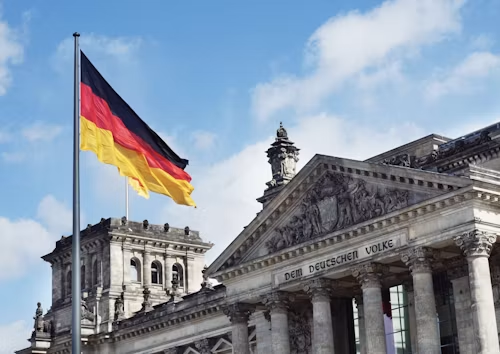
🇩🇪 Germany — 1871
Before 1871, there wasn't one unified country called Germany in the modern sense. The German-speaking lands were divided into numerous kingdoms, duchies, principalities and free cities.
The Holy Roman Empire had existed for centuries, but it wasn't a German nation-state in the modern sense. It was a complex collection of territories.
After the Napoleonic period, the German Confederation was created in 1815. Prussia then became increasingly dominant, and Otto von Bismarck helped bring the northern and southern German states together.
The German Empire was proclaimed in 1871
Interesting angle: Germany as a unified nation-state is younger than the telephone, the American Civil War and the first underground railway.
🇮🇹 Italy — 1861
The Italian peninsula was divided between different states, including the Kingdom of Sardinia, Kingdom of the Two Sicilies, Papal States, Grand Duchy of Tuscany and others.
The movement to unify Italy is known as the Risorgimento.
The Kingdom of Italy was proclaimed in 1861, although the unification process wasn't completely finished then. Rome was incorporated into the Kingdom in 1870.
So if you're thinking of "Italy" as the unified country we recognise today, it's only around 165 years old.
And there's a great connection here: German unification followed Italy's example, with the creation of the Kingdom of Italy in 1861 helping inspire German nationalists.
🇷🇴 Romania — 1859/1878
In 1859, Moldavia and Wallachia united under the same ruler, creating the basis of modern Romania.
The union was formally consolidated as Romania in 1862. Romania's independence from the Ottoman Empire was recognised internationally in 1878.
🇬🇷 Greece — 1830
The Greek War of Independence began in 1821, and Greek independence was recognised by the Great Powers around 1830.
So ancient Greek civilisation is thousands of years old, while the modern Greek state is less than 200 years old.
5. 🇧🇪 Belgium — 1830
Belgium declared independence from the Netherlands in 1830 and became an independent kingdom.
🇦🇱 Albania — 1912
Albania declared independence from the Ottoman Empire on 28 November 1912.
That means someone born in the early 20th century could theoretically have lived during the entire existence of the modern Albanian state.
🇹🇷 Turkey — 1923
The Ottoman Empire existed for centuries, but the modern Republic of Turkey was proclaimed on 29 October 1923, following the collapse of the Ottoman Empire after the First World War.
🇸🇦 Saudi Arabia — 1932
The modern Kingdom of Saudi Arabia was established in 1932, when Abdulaziz Ibn Saud unified the territories he controlled.
So although the Arabian Peninsula has an extraordinarily long history, the modern country of Saudi Arabia is less than 100 years old.
🇦🇺 Australia — 1901
The Commonwealth of Australia was established on 1 January 1901, when six British colonies federated.
So the country as a federation is only about 125 years old, despite Aboriginal societies having histories extending back tens of thousands of years.
🇨🇿 Czech Republic / Czechoslovakia — 1918 / 1993
There is a country called the Czech Republic, but the modern state has a complicated history.
Czechoslovakia was created in 1918 after the First World War.
Then, on 1 January 1993, Czechoslovakia peacefully split into the Czech Republic and Slovakia.
So the Czech Republic in its current form is only about 33 years old.History vs modern countries
The important thing to remember is this: a place can have thousands of years of history, but the country that governs it today may be surprisingly new.
Borders change. Empires rise and fall. Names and governments are created, dissolved, and reimagined.
So when we ask "how old is this country?", the answer depends on what we actually mean. Are we asking how long people have lived there? Or how long the modern nation-state has existed with its current name, borders, and government?
The land may be ancient — but the country standing upon it today may be younger than you think.