The World According to Homer
Almost 3,000 years ago, a blind poet named Homer is said to have composed two great poems — The Iliad and The Odyssey. What most people don't realise is just how much of our language, our stories and our ideas still come from those ancient lines.
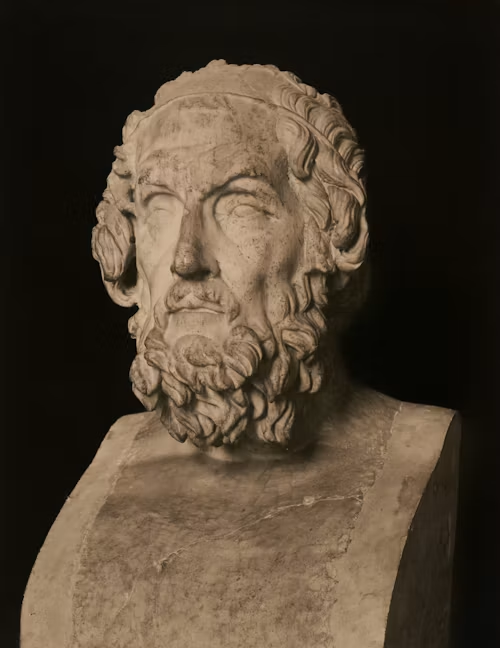
The man and the poems
We aren't even certain Homer was one single person. Some believe he was; others think the poems were built up over centuries by many storytellers. But it doesn't really matter — because The Iliad and The Odyssey became the foundation of Western literature, education and storytelling.
And here is the surprising part: you probably already know more Homer than you think. Phrases, ideas, images — even whole plots — have travelled down through 100 generations. Here are the stories and sayings that came from Homer.
Achilles' Heel — Your Only Weakness
We all say it: "He has an Achilles' heel." Meaning: your one great weakness, despite being strong everywhere else.
From The Iliad: The hero Achilles was dipped in the River Styx as a baby to make him invincible. But his mother held him by the heel — so that one spot never touched the water. Years later, in the Trojan War, an arrow struck him — right in that heel.
Today we speak of an "Achilles' heel" and hardly anyone stops to think: that is nearly 3,000‑year‑old poetry.
The Trojan Horse — Beware Greeks Bearing Gifts
"Beware of enemies bringing gifts." That idea — and the famous wooden horse — comes from The Odyssey.
After ten years of war, the Greeks sailed away leaving behind a giant wooden horse. The Trojans dragged it inside their city walls — believing it was a peace offering. That night, hidden soldiers crept out, opened the gates, and Troy fell.
Today we call something that looks like a gift but is actually a trap a "Trojan Horse" — even computer viruses carry the name. All from Homer.
The Odyssey — The Long Journey Home
We often call any long, difficult journey "an odyssey". That word comes directly from Homer's second great poem — the story of Odysseus.
After the Trojan War ended, it took Odysseus ten more years just to get back home. He faced storms, monsters, giants, enchantresses, the dead, and temptations. Every modern story about "the long journey home" owes something to Homer.
Between a Rock and a Hard Place
Stuck between two dangers — and either way you turn, things look bad. We say it all the time. It comes from The Odyssey.
Odysseus had to sail through a narrow strait. On one side: Scylla — a six‑headed monster who snatched sailors off the decks. On the other: Charybdis — a giant whirlpool that swallowed the whole ship.
He had to choose: lose six men to the monster — or lose everyone to the whirlpool. That is where "between Scylla and Charybdis" came from — and over time it became "between a rock and a hard place".
The Sirens — Beautiful but Deadly
"Siren voices" — temptation that sounds beautiful but leads to ruin. That comes from Homer too.
The Sirens were creatures who sang so beautifully sailors forgot everything, steered toward them, and died on the rocks. Odysseus wanted to hear them — so he ordered his men to plug their ears with wax and tie him to the mast. He heard the song — and they sailed safely past.
Today we speak of "siren voices" or "the song of the Sirens" — and it is still Homer's story.
Helen — The Face That Launched a Thousand Ships
The most beautiful woman in the world. Her leaving triggered a ten‑year war. That is Helen of Troy.
Paris, prince of Troy, took Helen away from her husband Menelaus. The Greeks sailed to get her back. And so began the Trojan War.
"The face that launched a thousand ships" — a phrase made famous because Homer's story tells us that one woman's beauty started a war involving hundreds of ships and thousands of men.
The Choice That Started It All
Eris, the goddess of discord, rolled a golden apple marked "For the Fairest" into a wedding. Three goddesses claimed it: Hera, Athena and Aphrodite.
Paris was asked to choose. Hera offered him power. Athena offered wisdom and victory in war. Aphrodite offered him the most beautiful woman in the world — Helen.
Paris chose Aphrodite. And that choice — one young man's decision — started the Trojan War.
"My Name is Nobody"
Odysseus was trapped in the cave of the giant Cyclops, Polyphemus. To trick him, Odysseus told the giant his name was "Nobody".
Later, when Odysseus blinded him, the giant screamed out to his neighbours for help. They shouted back: "Who is hurting you?" And Polyphemus roared: "Nobody!" So they said: "Then we cannot help you."
One of the oldest — and cleverest — tricks in all literature.
The Golden Age — Things Were Better Before
We speak of "the good old days" or "a Golden Age". The idea comes from the ancient poets — including Homer — who looked back at the heroes of old and believed they were stronger, nobler, and greater than people today.
Homer's heroes — Achilles, Hector, Odysseus, Agamemnon — were seen as giants of a former age. And so began the idea that there was once a time when the world was better.
Why Homer Still Lives
Think about it: nearly 3,000 years have passed. Empires have risen and fallen. Languages have changed. Whole civilisations have turned to dust.
And yet — we still say "Achilles' heel". We still warn about "Trojan Horses". We still talk about "odysseys" and "siren voices" and being "between a rock and a hard place".
A blind poet — or a tradition of poets — told these stories so beautifully that they have never stopped being told. Long after every other name from that time was forgotten, Homer is still speaking.
The stories that never ended
You don't need to have read The Iliad or The Odyssey to know Homer. He is already in your language. He is already in the stories you watch, the books you read, and the phrases you speak.
Every time you speak of someone having their "Achilles' heel", or warn about a "Trojan Horse", or describe a long journey as "an odyssey" — you are quoting poetry that was written nearly 3,000 years ago.
And that is the greatest miracle of all: the voice of Homer is still being heard.