Why the Moon Pulls the Sea
Twice every day the sea rises. Twice every day it falls. We call it the tide. And the reason it happens — is the Moon. But how can something so far away reach across empty space and pull all that water up?
Gravity is the invisible string
Everything that has mass — anything made of anything — pulls on everything else. It's called gravity. The bigger the thing, the stronger the pull. The closer it is, the stronger the pull.
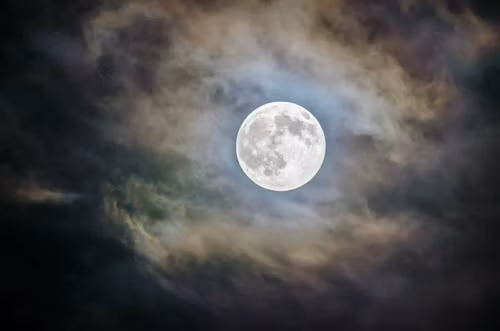
The Moon is much smaller than Earth — but it is also very close in space terms. So close that its gravity reaches all the way here. And when it pulls — the water in our oceans moves. Because water is liquid — it can flow. So it bulges up towards the Moon.
That is the tide.
Why we get TWO tides every day
Here is the part that surprises most people: if the Moon pulls the water towards it, you would expect one high tide — directly under the Moon. But we actually get two high tides every single day — roughly 12 hours apart.
Why? Because the Moon pulls harder on the side of Earth facing it than it does on Earth's centre. And it pulls weakest of all on the side facing away.
Think of it like this: the Moon pulls the nearest water away from the Earth → that's one bulge. And it pulls the solid Earth itself away from the farthest water → that's a second bulge on the opposite side!
So Earth spins around once under these two bulges. Wherever you live, the planet turns through a bulge → high tide. Then through the low water in between → low tide. Then through the second bulge → high tide again. That is why we get two highs and two lows — almost every day.
The Sun helps too — sometimes
The Sun is enormously bigger than the Moon — but it is also much farther away. So its tide‑pull is only about half as strong as the Moon's. Still, it matters.
When the Sun, Moon and Earth line up in a straight line — at Full Moon and New Moon — their pulls add together. The tides become extra high and extra low. These are called Spring Tides — nothing to do with the season, simply because the water "springs up" higher.
When the Sun and Moon are pulling at right angles to each other — halfway between those times — the Sun partly cancels out the Moon's pull. The tides are weaker. These are called Neap Tides.
Why the tide gets later each day
You might notice high tide isn't at exactly the same time every day — it creeps about 50 minutes later each day. Why?
Because while Earth spins, the Moon is also moving — travelling in its own orbit around us. Earth has to spin a little bit extra to catch up to where the Moon has gone. That extra bit takes roughly 50 minutes. So the tides run on Moon time — not Sun time.
Why tides differ around the world
If Earth were perfectly smooth and covered in deep water everywhere, the tides would be about the same everywhere. But our continents get in the way. Oceans are different shapes. Seafloors are different depths. Narrow funnels and shallow bays squeeze the water — making the tide rise and fall much more.
That is why the UK — surrounded by ocean and with many funnel‑shaped inlets — has such dramatic tides. In some places the sea barely moves. In others — like the Bristol Channel — the difference between high and low water can be over 14 metres!
In simple terms
🌊 Gravity from the Moon pulls the oceans upward
🌍 Two bulges form — one facing the Moon, one opposite
🔁 Earth spins beneath them → two high tides daily
☀️ Sun joins in → extra high (Spring) or weaker (Neap)
🕔 50 minutes later each day — because the Moon moves on
The invisible connection
So the next time you stand at the shore and watch the tide come in — remember: that water is being lifted up by something you cannot feel, something a quarter of a million miles away. An invisible bridge of gravity stretching across space.
The Moon tugs. And the whole ocean answers.